The is the win record differentials for many long term starters that played their career in the 1970s and 1980s.
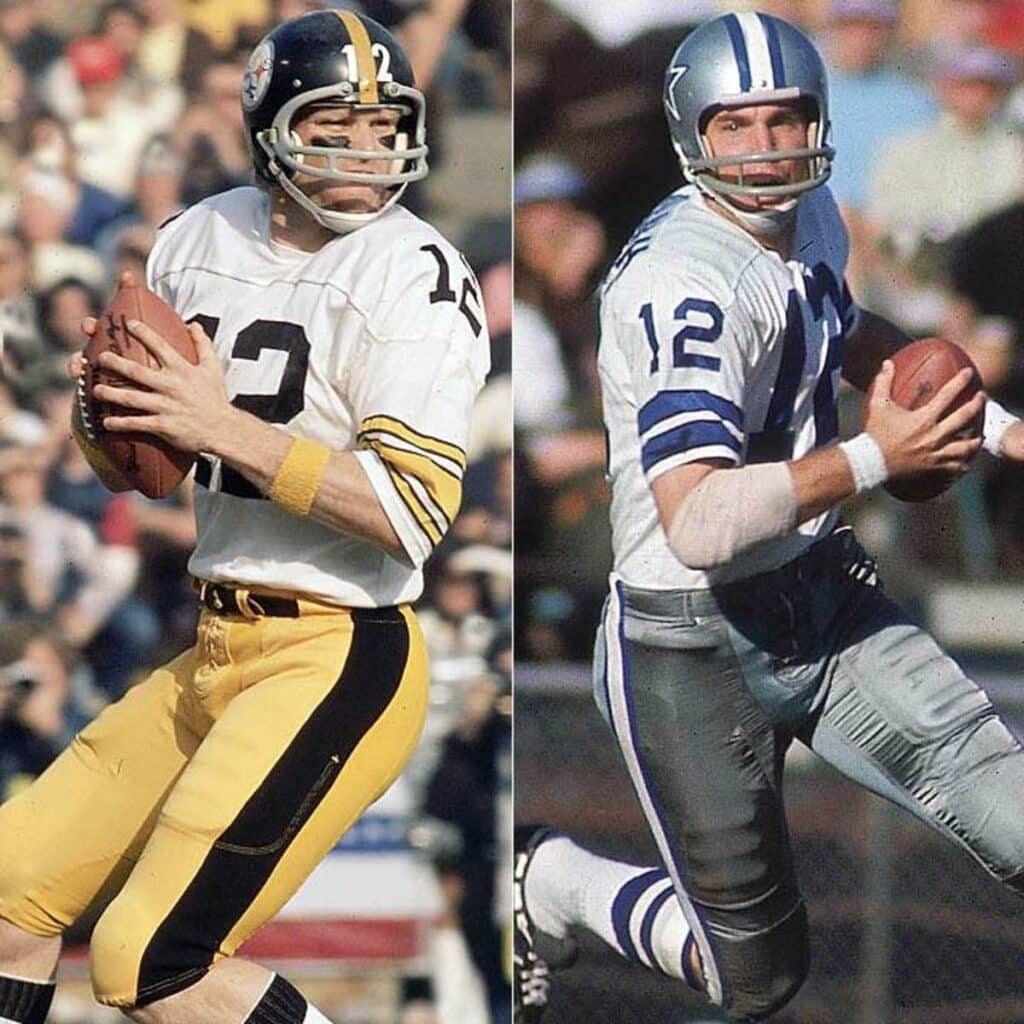
Roger Staubach
| Seasons | Teams | Record | Projected | +/- | Context |
| 1969 | DAL | 1-0 | 0.94-0.06 | 0.06 | was the backup, had head coach Tom Landry for his whole career in Dallas |
| 1970 | DAL | 2-1 | 2.40-0.60 | -0.40 | was the backup, G Niland made a pro bowl |
| 1971 | DAL | 10-0 | 7.56-2.44 | 2.44 | RB Thomas and FB Garrison are productive, G Niland and RT Wright made all-pro |
| 1972 | DAL | 0-0 | 0-0 | 0 | barely played/did not start , RT Wright made all-pros from 1972-1974, G Niland made all-pro, RB Hill made pro bowls from 1972-1974, FB Garrison made a pro bowl |
| 1973 | DAL | 10-4 | 9.91-4.09 | 0.09 | only 1 game winning drive, G Niland made a pro bowl |
| 1974 | DAL | 8-6 | 8.05-5.95 | -0.05 | 3 gw drives, G Niland regressed but G Nye made a pro bowl, WR Pearson made all-pro |
| 1975 | DAL | 9-4 | 6.97-6.03 | 2.03 | 3 gw drives, Niland left, RT Wright made a pro bowl |
| 1976 | DAL | 11-3 | 9.54-4.46 | 1.46 | G Nye made a pro bowl, WR Pearson and RT Wright made all-pro, TE DuPree made pro bowls from 1976-1978 |
| 1977 | DAL | 12-2 | 9.20-4.80 | 2.80 | 3 gw drives, Reeves replaced Jim Meyers as the OC, WR Pearson made all-pro, RB Dorsett was drafted and was productive, RT Wright no longer starting/regressed |
| 1978 | DAL | 11-4 | 9.62-4.38 | 1.38 | 3 game winning drives, RB Dorsett and WR Tony Hill made a pro bowl |
| 1979 | DAL | 11-5 | 8.23-7.77 | 2.77 | 4 game winning drives, LT Donovan and G Scott made a pro bowl, WR Pearson and RB Dorsett were productive, WR Hill made a pro bowl, TE DuPree regressed |
Terry Bradshaw
| Seasons | Teams | Record | Projected | +/- | Context |
| 1970 | PIT | 3-5 | 4.83-3.18 | -1.83 | didn’t start the remaining half of the season |
| 1971 | PIT | 5-8 | 5.79-7.21 | -0.79 | RB Pearson and FB Fugua are productive together |
| 1972 | PIT | 11-3 | 9.48-4.52 | 1.52 | RB Franco Harris was drafted and made a pro bowl |
| 1973 | PIT | 8-1 | 6.94-2.06 | 1.06 | only 1 game winning drive, missed 5 games, had defensive minded coach Chuck Noll as the head coach during his time there, RB Harris and G van Dyke made a pro bowl |
| 1974 | PIT | 5-2 | 5.14 1.86 | -0.14 | missed half the season, RB Harris made a pro bowl, WR Shankin made a pro bowl |
| 1975 | PIT | 12-2 | 10.61-3.39 | 1.39 | RB Harris made an all-pro, WR Shankin regressed but WR Swann emerged and made all-pro |
| 1976 | PIT | 4-4 | 4.96 3.04 | -0.96 | missed half the season, WR Swann missed 4 games, RB Harris made a pro bowl |
| 1977 | PIT | 9-5 | 8.09 5.91 | 0.91 | only 1 game winning drive, RB Harris and WR Swann made all-pro, WR Stallworth was productive from 1977-78 |
| 1978 | PIT | 14-2 | 12.12-3.88 | 1.88 | RB Harris made pro bowls from 1978-80, WR Swann made all-pro, C Webster made all-pros from 1978-81 |
| 1979 | PIT | 12-4 | 9.38-6.62 | 2.62 | 4 game winning drives, WR Stallworth made all-pro, WR Swann missed a few games |
| 1980 | PIT | 9-6 | 7.66-7.34 | 1.34 | 4 game winning drives, WR Stallworth missed almost all of the season |
| 1981 | PIT | 8-6 | 7.68-6.32 | 0.32 | TE Cunningham was productive, RB Harris and WR Swann regressed |
| 1982 | PIT | 6-3 | 5.63-3.37 | 0.37 | only 1 gw drive, didn’t start half the season, RT Larry Brown and C Webster made a pro bowl, WR Stallworth made a pro bowl despite missing half the season, RB Harris and WR Swann missed half the season |
| 1983 | PIT | 1-0 | 0.94-0.06 | 0.06 | on the bench as a backup |
Ken Stabler
| Seasons | Teams | Record | Projected | +/- | Context |
| 1968 | OAK | 0-0 | 0-0 | 0 | sent to the Continental Football League |
| 1969 | OAK | 0-0 | 0-0 | 0 | on the bench, head coach John Madden took over |
| 1970 | OAK | 0-0 | 0-0 | 0 | on the bench, not primary starter |
| 1971 | OAK | 1-0 | 0.94-0.06 | 0.06 | on the bench, not primary starter |
| 1972 | OAK | 0-1 | 0.04-0.96 | -0.04 | |
| 1973 | OAK | 8-2 | 7.96-3.04 | 0.04 | 3 game winning drives, FB Hubbard, G Upshaw, and LT Shell made a pro bowl, WR Biletnikoff made pro bowls from 1973-1974 |
| 1974 | OAK | 11-2 | 7.45-5.55 | 3.55 | LT Shell made all-pros from 1974-1975, G Upshaw made all-pros from 1974-1977, WR Cliff Branch made pro bowls from 1976-1978 |
| 1975 | OAK | 10-3 | 6.69-6.31 | 3.31 | |
| 1976 | OAK | 11-1 | 6.85-5.16 | 4.16 | 4 game winning drives, LT Shaw made a pro bowl, TE Casper made all-pros from 1976-79 |
| 1977 | OAK | 10-3 | 7.99-5.01 | 2.01 | only 1 game winning drive, LT Shell made all-pros from 1974-1975, C Dalby made a pro bowl, FB van Eeghan made all-pro |
| 1978 | OAK | 9-7 | 8.62-7.38 | 0.38 | 3 game winning drives, WR Branch made a pro bowl, G Upshaw regressed |
| 1979 | OAK | 9-7 | 7.26-8.74 | 1.74 | only 1 game winning drive, TE Chester made a pro bowl, WR Branch was productive |
| 1980 | HOU | 11-5 | 9.41-6.59 | 1.59 | 0 game winning drives, no standout receiver, LT Gray made and RB Campbell made an all-pro |
| 1981 | HOU | 5-7 | 4.97-7.04 | 0.03 | LT Gray and RB Campbell made a pro bowl |
| 1982 | NOR | 4-4 | 4.50-3.51 | -0.50 | missed half the season, RB Rogers made a pro bowl |
| 1983 | NOR | 7-7 | 5.78-8.22 | 1.22 | 4 game winning drives |
| 1984 | NOR | 0-0 | 0-0 | 0 | on the bench |
Bert Jones
| Seasons | Teams | Record | Projected | +/- | Context |
| 1973 | BAL (Colts) | 1-4 | 1.92-3.08 | -0.92 | didn’t start the last 11 games of the season |
| 1974 | BAL | 1-7 | 3.14-4.86 | -2.14 | missed 6 games, RB Mitchell and FB Olds are productive |
| 1975 | BAL | 10-4 | 7.13-6.87 | 2.87 | 3 game winning drives, offensive minded head coach Marchibroda replaced Schnellenberger, RT Kunz made all-pros from 1975-77, RB Mitchell made a pro bowl |
| 1976 | BAL | 11-3 | 7.59-6.41 | 3.41 | only 1 game winning drive, RB Mitchell and WR Roger Carr made all-pro |
| 1977 | BAL | 10-4 | 8.61-5.39 | 1.39 | RB Mitchell an all-pro, WR Carr regressed and missed most of the season |
| 1978 | BAL | 2-1 | 1.46-1.54 | 0.54 | only 1 game winning drive, RB Mitchell left but RB Washington arrived and was productive, RT Kunz missed basically the whole season, WR Carr regressed |
| 1979 | BAL | 3-1 | 1.86-2.14 | 1.14 | got hurt very early in the yr, RB Washington made a pro bowl, RT Kunz was out all year |
| 1980 | BAL | 6-9 | 5.90-9.10 | 0.10 | got hurt very early in the yr, McCormack replaced Marchibroda as the head coach, RT Kunz didn’t start most of the season, WR Carr was productive |
| 1981 | BAL | 2-13 | 2.14-12.86 | -0.14 | 0 game winning drive, WR Carr regressed |
| 1982 | LAR | 1-3 | 1.36-2.64 | -0.36 | missed most of the season, G Hill made a pro bowl despite missing half the season |
Ken Anderson
| Seasons | Teams | Record | Projected | +/- | Context |
| 1971 | CIN | 0-4 | 1.67-2.34 | -1.67 | |
| 1972 | CIN | 7-6 | 7.92-5.08 | -0.92 | |
| 1973 | CIN | 10-4 | 8.58-5.42 | 1.42 | |
| 1974 | CIN | 7-6 | 7.45-5.55 | -0.45 | |
| 1975 | CIN | 10-3 | 7.24-5.76 | 2.76 | |
| 1976 | CIN | 10-4 | 8.85-5.15 | 1.15 | |
| 1977 | CIN | 7-6 | 8.04-4.96 | -1.04 | |
| 1978 | CIN | 4-8 | 7.06-4.94 | -3.06 | |
| 1979 | CIN | 4-11 | 5.72-9.28 | -1.72 | |
| 1980 | CIN | 5-7 | 5.69-6.31 | -0.69 | |
| 1981 | CIN | 12-4 | 8.11-7.90 | 3.90 | |
| 1982 | CIN | 7-2 | 5.00-4.00 | 2.00 | |
| 1983 | CIN | 5-8 | 7.59-5.41 | -2.59 | |
| 1984 | CIN | 3-6 | 3.22-5.78 | -0.22 | |
| 1985 | CIN | 0-2 | 0.21-1.79 | -0.21 | |
| 1986 | CIN | 0-0 | 0-0 | 0 |
Dan Fouts
| Seasons | Teams | Record | Projected | +/- | Context |
| 1973 | SD | 0-5 | 1.47-4.53 | -1.47 | didn’t start most of the season |
| 1974 | SD | 3-8 | 4.70-6.30 | -1.70 | Prothro replaced Svare as the head coach, RT Washington made pro bowls from 1974-75, RB Woods was drafted and productive |
| 1975 | SD | 2-7 | 4.06-4.94 | -2.06 | missed 5 games, only 1 game winning drive, RB Woods missed most of the season |
| 1976 | SD | 5-8 | 5.24-7.76 | -0.24 | WR Joiner made a pro bowl |
| 1977 | SD | 2-2 | 2.39-1.61 | -0.39 | missed most of the season, WR Joiner regressed, RT Washington made pro bowls from 1977-78 |
| 1978 | SD | 9-5 | 7.26-6.74 | 1.74 | offensive minded head coach Don Coryell took over for Prothro during the season as the head coach, WR John Jefferson was drafted and made all-pros from 1978-89, RB Mitchell arrived and him with Woods combined are productive |
| 1979 | SD | 12-4 | 10.59-5.42 | 1.42 | only 1 game winning drive, RT Washington and G White made all-pro, WR Joiner made a pro bowl |
| 1980 | SD | 11-5 | 8.34-7.66 | 2.66 | RB Mitchell left, RB Woods left during the season, not a productive run game, RT Washington missed most of the season, TE Winslow emerged and made all-pro from 1980-1982, WR Joiner made all-pro, G Wilkerson emerged and made a pro bowl |
| 1981 | SD | 10-6 | 6.76-9.25 | 3.25 | WR Jefferson left, RB Muncie and G Wilkerson made a pro bowl, WR Joiner was productive |
| 1982 | SD | 6-3 | 3.20-5.80 | 2.80 | RT Washington and G Wilkerson made all-pro, WR Chandler made all-pro despite missing half of the season, WR Joiner missed half the season |
| 1983 | SD | 5-5 | 2.47-7.53 | 2.53 | missed 6 games, 3 game winning drive, RT Washington retired, WR Chandler made a pro bowl, RB Muncie regressed |
| 1984 | SD | 6-7 | 4.69-8.31 | 1.31 | only 1 game winning drive, RB Earnest Jackson made a pro bowl |
| 1985 | SD | 7-5 | 4.34-7.66 | 2.66 | G Wilkerson retired, RB Jackson left, WR Chandler made a pro bowl, RB Jackson missed 5 games and regressed |
| 1986 | SD | 3-9 | 4.10-7.90 | -1.10 | offensive minded Al Saunders took over for Coryell as the head coach halfway through the season, RB Gary Anderson made a pro bowl, TE Winslow was productive |
| 1987 | SD | 5-5 | 4.61-5.39 | 0.39 | RB Anderson missed half the season, LT Lachey made all-pro, TE Winslow made all-pro but wasn’t dominant |
Joe Theismann
| Seasons | Teams | Record | Projected | +/- | Context |
| 1971 | N/A | 0-0 | 0-0 | 0 | he went to the CFL to negotiation issue, otherwise he would have been in the NFL. Was there from 1971-1973 |
| 1972 | N/A | 0-0 | 0-0 | 0 | |
| 1973 | N/A | 0-0 | 0-0 | 0 | |
| 1974 | WAS | 0-0 | 0-0 | 0 | on the bench this year and next |
| 1975 | WAS | 0-0 | 0-0 | 0 | Waller replaced Marchibroda as the OC, RB Thomas was drafted and productive |
| 1976 | WAs | 3-2 | 3.19-1.81 | -0.19 | not the primary starter/didn’t start most of the season this yr and next, RB Thomas made a pro bowl |
| 1977 | WAS | 4-2 | 4.85-1.15 | -0.15 | TE Fugett made a pro bowl |
| 1978 | WAS | 7-7 | 8.10-5.90 | -1.10 | Pardee replaced George Allen as the head coach, RB Riggins was productive from 1978-1979 |
| 1979 | WAS | 10-6 | 8.85-7.16 | 1.16 | 4 game winning drives, TE Fugett regressed |
| 1980 | WAS | 6-9 | 8.12-6.88 | -2.12 | TE Fugett retired, Riggins out all year |
| 1981 | WAS | 8-8 | 6.99-9.01 | 1.01 | offensive minded head coach Gibbs replaced Pardee as the head coach, RB Riggins missed many games this year and next year |
| 1982 | WAS | 8-1 | 6.21 -2.79 | 1.79 | WR Charlie Brown made pro bowls from 1982-83 |
| 1983 | WAS | 14-2 | 8.05-7.95 | 5.95 | 4 game winning drives, RB Riggins made an all-pro, LT Jacoby made all-pros from 1983-83, G Grimm made all-pros from 1983-86 |
| 1984 | WAS | 11-5 | 8.28-7.72 | 2.72 | 3 game winning drives, RB Riggins regressed this year and next, WR Brown missed games, WR Monk made all-pros from 1984-85 |
| 1985 | WAS | 6-5 | 6.77-4.23 | -0.77 | got career ending injury during the season, 0 game winning drives, WR Brown retired, LT Jacoby made a pro bowl from 1985-86 |
Bob Griese
| Seasons | Teams | Record | Projected | +/- | Context |
| 1967 | MIA | 3-7 | 3.04-6.96 | -0.04 | WR Clancey made a pro bowl, not a productive run game |
| 1968 | MIA | 5-7 | 5.44-7.56 | -0.44 | WR Clancey missed games and regressed before leaving after the season, WR Noonan made all-pro, RB Kiick made a pro bowl |
| 1969 | MIA | 2-6 | 3.67-5.33 | -1.67 | missed a few games, 0 game winning drives, WR Noonan regressed, RB Kiick made a pro bowl, TE Seiple was productive |
| 1970 | MIA | 10-4 | 8.95-5.05 | 1.05 | defensive minded head coach Don Shula replaced George Wilson, WR Warfield arrived and made a pro bowl, C Goode and G Little made a pro bowl, FB Csonka emerged and made a pro bowl, TE Seiple converted to punter, RB Kiick was productive from 1970-72 |
| 1971 | MIA | 9-3 | 10.04-2.96 | -1.04 | C Goode left, G Little made all-pros from 1971-75, WR Warfield and FB Csonka both made all-pros from 1971-73, RB Morris made pro bowls from 1971-73 |
| 1972 | MIA | 5-0 | 3.74-1.26 | 1.26 | RT Evans made a pro bowl |
| 1973 | MIA | 12-1 | 10.15-2.85 | 1.85 | only 1 game winning drive, LT Moore and C Langer made a pro bowl, RB Kiick regressed moving forward before leaving 2 years later |
| 1974 | MIA | 10-3 | 7.90-5.10 | 2.10 | 3 game winning drives, RB Kiick was productive, C Langer made all-pros from 1974-78, RT Evans and FB Csonka and WR Warfield made pro bowl, RB Morris and LT Moore missed most of the season, G Kuechenberg made pro bowls from 1974-1975 |
| 1975 | MIA | 7-3 | 5.89-4.11 | 1.11 | FB Csonka and WR Warfield left, RB Morris and WR Nat Moore was productive |
| 1976 | MIA | 5-8 | 6.74-6.26 | -1.74 | RB Morris left |
| 1977 | MIA | 10-4 | 10.19-3.81 | -0.19 | 0 game winning drives, G Little made all-pros from 1977-78, WR Moore made an all-pro, G Kuechenberg made a pro bowl |
| 1978 | MIA | 6-3 | 5.11-3.89 | 0.89 | WR Moore was productive from 1978-80, G Kuechenberg and RB Delvin Williams made an all-pro |
| 1979 | MIA | 7-5 | 8.58-3.42 | -1.58 | only 1 game wining drive, C Langer missed half the season |
| 1980 | MIA | 1-2 | 1.22-1.78 | -0.22 | missed most of the season, G Little missed most of the season |
Analysis
Staubach was drafted in 1964, but he spent years on military duty. As a result, he did not play until 1969. Those years on military duty do not count when accounting for his record differentials. The first year counted is 1969 for Staubach. The reason his military service years do not count despite being drafted in 1964 is because he did not play professional football in any capacity and was not out of the league due to being cut. He had to do military service.
When Staubach became a full-time starter, he alternated between winning almost 3 games above average and winning a little over a game above average. He had a few average seasons in one of his earlier seasons as a starter and in limited starts when he was a primary backup. His worst seasons were when he finished just barely below average. An example of this was in 1975 when his record differential was -0.05. Staubach avoided low floors such as winning over a game below average in a season. As a result, he ended up winning a little over a game above average despite not having a huge peak such as winning over 3 games above average.
Bradshaw had negative record differentials for his first few seasons, although he was young. He started winning at least a game above average once star running back Franco Harris was drafted to the Steelers. Bradshaw’s marginally below average seasons during the next several years came in seasons that he would miss large portions of it. He did not peak higher than a little over a game above average during the 1970s even with the emergence of excellent receivers. He started to approach around 2 games won above average in 1978 and 1979. This occurred after the 1978 rule changes which allowed offensive linemen to fully extend their arms when blocking and also limited contact with receivers after 5 yards past the line of scrimmage. He did not sustain the wins and was basically average in his ability to win. It coincided with him aging along with some of his longtime offensive standouts regressing and aging as well.
Bradshaw had very strong defensive support after 1971. In many of those seasons, the average quarterback would have won multiple games above .500. The defensive support was so strong that the average quarterback would have gone approximately 11-3 in 1975 and gone 12-4 in 1978.
The Raiders sent Stabler to the Continental Football League in his first year. This first year counts when calculating his career record differential for the regular season, and it is recorded as 0. If the Raiders felt Stabler was ready, then he would have had the opportunity to play, and it could have affected his record differential anyway. As a result, this year is still counted. For Stabler’s first few seasons, he was basically average in terms of winning, albeit he did not play that many games due to not being a full-time starter until 1973.
For most of his prime with the Raiders, Stabler got to play with two elite linemen in Shell and Upshaw. He also had a few excellent skill position players that came and went during his time with the team. From 1974-1978, Stabler won 2-4 games above average, which was even more excellent at the time. His peak season in that period was 1976, in which he won slightly over 4 games more than what the average quarterback would have done in that spot. In the following seasons, he oscillated between winning over a game above average and being just barely over average. This also coincided with him and his teammates aging, at least in his last few seasons.
Stabler’s defensive support ranged from having a few bad seasons, some decent seasons, and a few good seasons. Stabler having a four-year peak, avoiding significantly below average seasons, and having a few additional seasons of winning at least a game above average helped him win over one game compared to the average quarterback in the regular season. During Stabler’s peak, he won a notable number of games in which his defense would give up 26-33 points and 34+ points, respectively, compared to what the average quarterback would have done by a big margin.
Bert Jones won at a below average level in the first two seasons, albeit it was not uncommon for a young quarterback to struggle in his first few years in the 1970s. In 975, Jones’ third season, he received offensive help from offensive-minded head coach Marchibroda. During this season and the next couple of years, Jones also had elite performances from some of his offensive teammates.
From 1975-1977, Jones averaged 1-3.5 games won above average. His peak season was 1976, in which he won 3.4 games above average. In the following couple of seasons, Jones sustained injuries that forced him to miss most of 1978 and 1979, which translated to a slightly lesser record differential in that span. In Jones’ final three seasons, the offensive talent around him regressed and or left, and his coach Marchibroda left. It coincided with Jones’ decline as he was basically marginally below average and average in that span. Jones had sub-mediocre defensive support in his couple of seasons, good defensive support in the middle portion, and then bad to terrible defensive support in his final few years. The average quarterback would have gone 2-13 in the 15 starts Jones had in 1981.
When Jones was healthy in his prime and had excellent offensive talent with an offensive-minded head coach in Marchibroda, he was very good when it came to added wins. The issue comes down to whether Jones’ struggles with sustaining his success were primarily due to injuries or the changes in offensive help around him, or even his own play sustainability might have played a notable role instead.
Prior to 1981, Anderson was very inconsistent as he would have seasons winning 1-2 games above average but also have seasons winning 1-3 games below average. There were very limited standouts on offense and the inconsistencies in his ability to produce wins were not influenced by changes with the head coach during that time. Anderson won almost 4 games above average in 1981 which was his peak, and he won 2 games above average in 1982. He had a few more stars on offense that time, specifically with wide receiver Chris Collinsworth. The receiver made all-pro during those two years. After 1983, Colinsworth went back to being average to below average as it coincided with Colinsworth regressing to just being productive and Anderson aging. In summary, Anderson found consistency and higher peaks winning when he had a receiver playing at an elite level. Except for a couple of years, Anderson had good defensive support since the average quarterback would have gone 2-3 games above .500.
Fouts won below average for the first five seasons of his career even when accounting for it being understandable for a young quarterback in his first couple of years to struggle during the 1970s. He had some seasons in which he lost over a game below average. This all happened even when he had at least a few really good offensive players around him. Things only changed when offensive-minded head coach Don Coryell arrived. During an 8-year stretch, Fouts averaged over a game to close to 3 games won above average. He declined after 1985 when he aged out of his prime. During his 8-year prime stretch with Coryell and the stars on offense, Fouts peaked at winning a little over 3 games above average in 1981.
Essentially, Fouts was only excellent when he had Don Coryell. To be fair, Coryell’s best success was when he had Fouts with the Chargers compared to his time with the Cardinals, albeit his Cardinals’ stint was before the 1978 rule changes. Fouts mostly had bad defensive support at the expense of the offense. The defensive support was bad in the sense that the average quarterback would have a record that was multiple games under .500. The exception was from 1978-1980, in which his defensive support ranged from solid to great, specifically in 1979.
Theismann was in the CFL for his few professional seasons. Those seasons are recorded as having record differentials of 0 and added when calculating his career regular season record differential. The reason is that he chose to go to the CFL due to negotiations with the NFL falling apart. Had he chosen to go to the NFL, those would have been seasons that he could have registered a record differential if he played or had one like 0 if was a backup with any starts. It has to be added, otherwise a quarterback that chose to play in the NFL would be punished if he struggled in his starts versus playing in a different league altogether early on.
Outside of one good season, Theismann won at a below average rate in his first few seasons playing as a spot starter and full-time start even when running back John Riggins. During that, Theismann did not have that many standouts on offense. Theismann started winning at least a game above average in the first couple of seasons of when offensive minded head coach Joe Gibbs arrived. When the offensive talent improved with the coaching with the emergence of a few all-pros on the offensive line and receiver position, Theismann improved tremendously. He peaked in 1983 by winning close to 6 games above average which would be considered an MVP by even today’s standards. He won close to 3 games above average in 1984. However, he couldn’t sustain this in 1985 as he was below average before having his career unfortunately cut short. To be fair, Theismann was older at that point so he might have been exiting his prime.
To Theismann’s credit, he peaked very high when he had offensive coaching from Gibbs and excellent offensive talent. However, he couldn’t sustain a decent median of at least winning a game above average even under those offensive circumstance after a few years before getting hurt. With the exception of 1981, Theismann mostly had solid to really good defensive support.