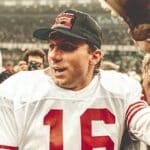
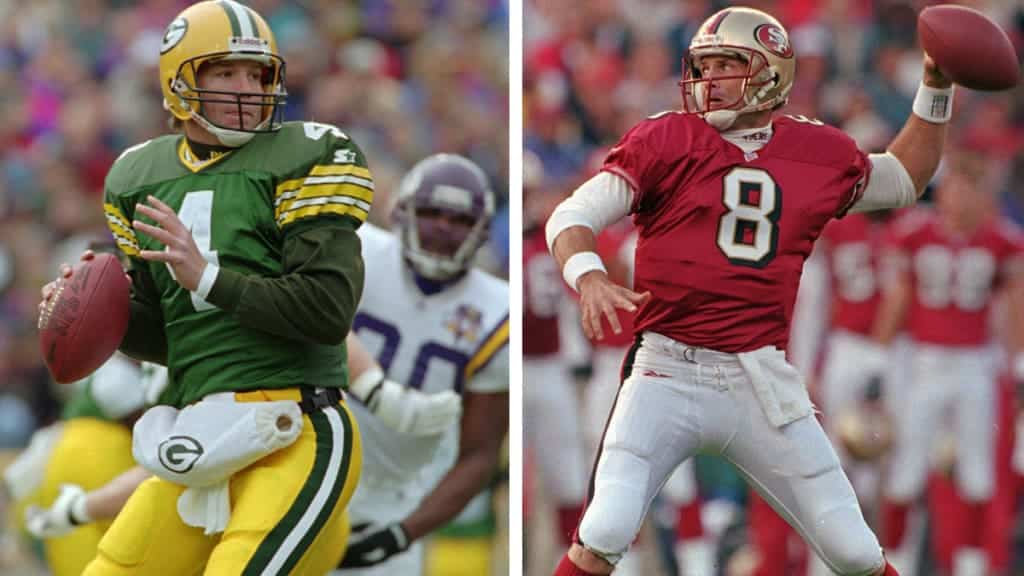
The is the win record differentials for many long term starters that came into the league in the late 1980s/early 1990s and played a lot of their careers in the 1990s.
Brett Favre
| Seasons | Teams | Record | Projected | +/- | Context |
| 1991 | ATL | 0-0 | 0-0 | 0 | on the bench, had defensive minded head coach Jerry Glanville |
| 1992 | GB | 8-5 | 7.66-5.34 | 0.34 | had offensive minded head coach Mike Holmgren, WR Sterling Sharpe made all-pro |
| 1993 | GB | 9-7 | 8.93-7.07 | 0.07 | WR Sharpe made all-pro, RB Thompson and FB Bennett combined to be productive together |
| 1994 | GB | 9-7 | 9.10-6.90 | -0.10 | WR Sharpe made a pro bowl, RB Cobb and FB Bennett combined to be productive |
| 1995 | GB | 11-5 | 8.05-7.95 | 2.95 | only 1 game winning drive, WR Sharpe retired but WR Brooks emerges and is very productive, FB Bennett is productive, TE Chmura made a pro bowl |
| 1996 | GB | 13-3 | 11.48-4.52 | 1.52 | only 1 game winning drive, C Winters made a pro bowl, G Timmerman is productive, WR Brooks missed half the season |
| 1997 | GB | 13-3 | 9.49-6.51 | 3.51 | 0 game winning drives despite being really good, TE Chmura and RB Levens made a pro bowl, WR Brooks is productive, WR Antonio Freeman emerges and is productive |
| 1998 | GB | 11-5 | 7.79-8.21 | 3.21 | WR Freeman made an all-pro, TE Chmura made a pro bowl, RB missed most of the season, WR Brooks regresses before leaving after the season |
| 1999 | GB | 8-8 | 7.00-9.00 | 1.00 | head coach Holmgren left and is replaced by defensive minded head coach Ray Rhodes, RB Green, WR Freeman, and WR Schroeder are productive |
| 2000 | GB | 9-7 | 7.49-8.51 | 1.51 | 4 game winning drives, head coach Rhodes is replaced by offensive minded head coach Mike Sherman, RB Ahman Green emerges and is productive |
| 2001 | GB | 12-4 | 9.41-6.59 | 2.59 | RB Green made an all-pro, TE Franks made a pro bowl, WR Freeman regressed |
| 2002 | GB | 12-4 | 8.16-7.84 | 3.84 | RB Green made pro bowls from 2002-2004, G Rivera and TE Franks made a pro bowl, WR Freeman left but WR Driver emerges and made a pro bowl |
| 2003 | GB | 10-6 | 8.28-7.72 | 1.72 | G Rivera made an all-pro, C Flannagan and TE Franks made a pro bowl |
| 2004 | GB | 10-6 | 7.56-8.44 | 2.44 | 4 game winning drives, G Rivera and WR Walker made a pro bowl, WR Driver is productive, FB Henderson made all-pro |
| 2005 | GB | 4-12 | 7.31-8.69 | -3.31 | G Rivera left, WR Walker missed most of the season before leaving after the season, RB Green missed most of the season |
| 2006 | GB | 8-8 | 6.66-9.34 | 1.34 | Sherman is replaced by offensive minded head coach Mike McCarthy, RB Green is productive, WR Driver made a pro bowl |
| 2007 | GB | 13-3 | 8.68-7.32 | 4.32 | 4 game winning drives, RB Green left, LT Clifton made a pro bowl, WR Driver made a pro bowl |
| 2008 | GB | 9-7 | 7.17-8.83 | 1.83 | had defensive minded head coach Eric Mangini, Favre hurt his shoulder later in the year, RB Thomas Jones made a pro bowl, C Mangold made a pro bowl, G Faneca made all-pro, WR Coles and WR Cotchery were productive |
| 2009 | GB | 12-4 | 8.56-7.44 | 3.44 | had offensive minded head coach Brad Childress, G Hutchinson and RB Peterson made all-pro, WR Rice and LT McKinnie made a pro bowl, TE Shiancoe was productive |
| 2010 | GB | 5-8 | 5.65-7.35 | -0.65 | RB Peterson made a pro bowl, WR Rice missed most of the season, LT McKinney and G Hutchinson both regressed, WR Harvin was productive |
Troy Aikman
| Seasons | Teams | Record | Projected | +/- | Context |
| 1989 | DAL | 0-11 | 3.62-7.38 | -3.62 | |
| 1990 | DAL | 7-8 | 8.15-6.85 | -1.15 | didn’t play well anyway despite 6 game winning drives, RB Emmitt Smith is drafted and made a pro bowl, TE Novacek arrived |
| 1991 | DAL | 7-5 | 6.08-5.92 | 0.92 | David Shula is replaced by Norv Turner as the offensive coordinator, RB Smith made all-pro from 1991-1995, WR Irvin emerged and made all-pro from 1991-1993, TE Novacek made all-pro |
| 1992 | DAL | 13-3 | 10.33-5.67 | 2.67 | only 1 game winning drive, TE Novacek made all-pro, Nate Newton moved to guard and made a pro bowl, C Stepnoski made all-pro |
| 1993 | DAL | 11-3 | 10.03-3.97 | 0.97 | only 1 game winning drive, G Newton made a pro bowl, FB Johnston and C Stepnoski made a pro bowl, T Erik Williams made an all-pro, TE Novacek made pro bowls from 1993-1995 |
| 1994 | DAL | 10-4 | 9.60-4.40 | 0.40 | only 1 game winning drive, defensive minded head coach Jimmy Johnson left and is replaced by offensive minded head coach Barry Switzer, FB Johnston, LT Tuinei, and WR Irvin made a pro bowl, G Newton and C Stepnoski made all-pro, T Williams missed most of the season |
| 1995 | DAL | 12-4 | 8.78-7.22 | 3.22 | G Newton made all-pro, Larry Allen emerged and made all-pro from 1995-2001 at G and T, LT Tuinei and WR Irvin made a pro bowl, C Stepnoski left but C Donaldson arrived and made a pro bowl |
| 1996 | DAL | 10-5 | 10.18-4.82 | -0.18 | G Newton made a pro bowl, C Donaldson made a pro bowl, TE Novacek retired, WR Irvin missed 5 games, T Tuinei regressed, RT Williams made all-pro, RB Smith regressed a bit |
| 1997 | DAL | 6-10 | 8.36-7.64 | -2.36 | C Donaldson retired, RT Williams made a pro bowl, T Tuinei didn’t play most of the season before leaving after this year, G Newton missed a few games and regressed |
| 1998 | DAL | 7-4 | 6.22-4.78 | 0.78 | 0 game winning drives, Switzer replaced by offensive minded head coach Chan Gailey, G Newton and RB Smith made a pro bowl, LT Tuinei left |
| 1999 | DAL | 7-7 | 7.88-6.12 | -0.88 | only 1 game winning drive, RT Williams and RB Smith made a pro bowl, G Newton left, WR Irvin missed most of the season |
| 2000 | DAL | 4-7 | 4.89-6.11 | -0.89 | Aikman missed 5 games, only 1 game winning drive, Gailey replaced by defensive minded coach Dave Campo, unproductive receiving core, WR Irvin retired, RB Smith is productive |
Steve Young
| Seasons | Teams | Record | Projected | +/- | Context |
| 1984 | N/A | 0-0 | 0-0 | 0 | not in the NFL |
| 1985 | TB | 1-4 | 1.78-3.22 | -0.78 | on the bench, not the primary starter, TE Giles made a pro bowl |
| 1986 | TB | 2-12 | 3.08-10.92 | -1.08 | not a productive receiving core |
| 1987 | SF | 2-1 | 2.04-0.96 | -0.04 | had offensive minded head coach Bill Walsh, on the bench/not primary starter until 1991, RB Craig made a pro bowl, WR Rice won offensive player of the year, RT Fahnhorst missed most of the season, WR Clark regressed |
| 1988 | SF | 2-1 | 1.30-1.70 | 0.70 | WR Rice continued making all-pro from 1988-1990, RB Craig made an all-pro, RT Fahnhorst and WR Clark retired, WR Taylor technically made a pro bowl |
| 1989 | SF | 3-0 | 2.63-0.37 | 0.37 | defensive minded head coach Seifert replaced Walsh, WR Taylor made all-pro, RB Craig made a pro bowl, G McIntyre made pro bowls from 1989-1993 including an all-pro in 1992 |
| 1990 | SF | 0-1 | 0.76-0.24 | -0.76 | |
| 1991 | SF | 5-5 | 6.70-3.30 | -1.70 | 0 game winning drives, became primary starter, missed final 6 games, RB Craig left, WR Rice and G McIntyre made a pro bowl, not a very good run game |
| 1992 | SF | 14-2 | 10.87-5.13 | 3.13 | 5 game winning drives, Mike Shanahan replaced Holmgren as the OC, Watters made pro bowls from 1992-1996, WR Rice made all-pros from 1992-1996, G McIntyre, RT Barton, and LT Wallace made an all-pro, TE Jones made a pro bowl |
| 1993 | SF | 10-6 | 8.91-7.09 | 1.09 | 0 game winning drives, G McIntyre made a pro bowl, C Sapolu made a pro bowl, TE Brent Jones and RT Barton made an all-pro, WR Taylor is productive |
| 1994 | SF | 13-3 | 8.84-7.16 | 4.16 | 1 game winning drive, G McIntyre and RB Watters left, TE Jones made an all-pro, Sapolu converted to G and made a pro bowl, C Oates arrived and made a pro bowl, RT Barton missed 6 games |
| 1995 | SF | 8-3 | 6.45-4.55 | 1.55 | 0 game winning drives, Trestman replaced Shanahan as OC, TE Jones and C Oates made a pro bowl |
| 1996 | SF | 9-3 | 7.61-4.39 | 1.39 | Oates retired |
| 1997 | SF | 12-3 | 9.34-5.66 | 2.66 | 1 game winning drive, offensive minded head coach Mariucci replaced Seifert, LT Wallace left, RT Barton retired, WR Rice missed basically the whole season, RB Hearst arrived and was productive, G Gogan arrived and made a pro bowl |
| 1998 | SF | 11-4 | 7.36-7.64 | 3.64 | WR Rice and RB Hearst made a pro bowl, G Gogan made an all-pro |
| 1999 | SF | 2-1 | 1.36-1.64 | 0.64 | missed almost all of the season, RB Hearst missed the whole season, G Gogan left |
Drew Bledsoe
| Seasons | Teams | Record | Projected | +/- | Context |
| 1993 | NE | 5-7 | 6.07-5.93 | -1.07 | TE Coates was productive |
| 1994 | NE | 10-6 | 8.19-7.81 | 1.81 | TE Coates made an all-pro, LT Bruce Armstrong made a pro bowl |
| 1995 | NE | 6-9 | 6.50-8.50 | -0.50 | LT Armstrong made a pro bowl, RB Martin was drafted and made a pro bowl, TE Coates made an all-pro |
| 1996 | NE | 11-5 | 8.14-7.86 | 2.86 | 4 game winning drives, LT Armstrong made an all-pro, WR Glenn is drafted and is productive, RB Martin and TE Coates made a pro bowl |
| 1997 | NE | 10-6 | 8.81-7.19 | 1.19 | only 1 game winning drive, defensive minded head coach Pete Caroll replaced defensive head coach Bill Parcels, LT Armstrong and TE Coates made a pro bowl, WR Glenn missed half of the season |
| 1998 | NE | 8-6 | 7.09-6.91 | 0.91 | 4 game winning drives but was still average, RB Martin left but RB Edwards is drafted to replace him and is productive, Zampese replaced Kennan as OC, TE Coates made all-pro, WR Glenn missed half the season |
| 1999 | NE | 8-8 | 8.92 7.08 | -0.92 | TE Coates regressed, WR Glenn made a pro bowl, WR Edward is out all season due to injury and out moving forward in next few years before leaving |
| 2000 | NE | 5-11 | 7.23 8.77 | -2.23 | 0 game winning drives, TE Coates left, defensive head coach Belichick replaced defensive head coach Carroll. WR Glenn is productive |
| 2001 | NE | 0-2 | 1.32 0.68 | -1.32 | got hurt very early and missed the rest of the season, LT Armstrong left, WR Glenn was out for basically the whole season |
| 2002 | BUF | 8-8 | 6.22 9.78 | 1.78 | 4 game winning drives, had defensive head coach Gregg Williams, G Reuben Brown and WR Moulds made all-pro, RB Henry made a pro bowl |
| 2003 | BUF | 6-10 | 9.00 7.00 | -3.00 | only 1 game winning drive, G Brown made a pro bowl, WR Moulds missed a few games and regressed, RB Henry was productive |
| 2004 | BUF | 9-7 | 9.16 6.84 | -0.16 | 0 game winning drives, offensive minded head coach Mike Mularkey replaced Gregg Williams, G Brown regressed and missed half the season, WR Moulds is productive, RB Henry missed most of the season but is replaced by RB Henry whom was drafted and productive |
| 2005 | DAL | 9-7 | 8.70 7.30 | 0.30 | 5 game winning drives, had defensive head coach Parcels – technically no offensive coordinator by title this season and next, WR Glenn and Keyshawn Johnson are productive, TE Witten made a pro bowl, G Larry Allen made a pro bowl, LT Adams missed most of the season |
| 2006 | DAL | 3-3 | 3.09 2.91 | -0.09 | got benched after 6 games, G Larry Allen made a pro bowl, LT Adams, TE Witten, and C Gurode made a pro bowl |
Steve McNair
| Seasons | Teams | Record | Projected | +/- | Context |
| 1995 | HOU/TEN (Oilers/Titans | 2-0 | 1.46-0.54 | 0.54 | had defensive minded head coach Jeff Fisher for whole time in Tennessee, not the primary starter this year and next, C Stepnoski made a pro bowl, G Matthews made a pro bowl, WR Jeffries was productive |
| 1996 | HOU/TEN | 2-2 | 2.10-1.90 | -0.10 | WR Jefrries left, C Stepnoski made an all-pro, G Matthews made all-pro, RB George was drafted and was productive |
| 1997 | HOU/TEN | 8-8 | 8.01-7.99 | -0.01 | Steckel replaced Rhome as the OC, G Matthews made a pro bowl, RB George made a pro bowl from 1997-98 |
| 1998 | HOU/TEN | 8-8 | 8.05-7.95 | -0.05 | G Matthews made all-pros from 1998-2000, TE Wycheck made pro bowls from 1998-99 |
| 1999 | HOU/TEN | 9-2 | 5.15-5.85 | 3.85 | C Stepnoski retired, RB George made all-pros from 1999-2000 |
| 2000 | HOU/TEN | 13-3 | 11.77-4.23 | 1.23 | Heimerdinger replaced Steckel as OC, LT Hopkins made a pro bowl, WR Mason and Wycheck both made an all-pro |
| 2001 | HOU/TEN | 7-8 | 5.50-9.50 | 1.50 | G Matthews made a pro bowl, George regressed |
| 2002 | HOU/TEN | 11-5 | 8.65-7.35 | 2.35 | G Matthews retired, RB George was productive from 2002-03. TE Wycheck regressed this year and next year before leaving after 2003, WR Mason was productive |
| 2003 | HOU/TEN | 10-4 | 6.82-7.18 | 3.18 | LT Hopkins and WR Mason made a pro bowl |
| 2004 | HOU/TEN | 3-5 | 4.02-3.98 | -1.02 | missed half of the season, RB George left, WR Mason and WR Bennett were productive |
| 2005 | HOU/TEN | 4-10 | 4.66-9.34 | -0.66 | Chow replaced Heimerdinger as OC, WR Mason left |
| 2006 | HOU/TEN | 13-3 | 11.59-4.41 | 1.41 | had offensive minded head coach Brian Billick, LT Ogden made all-pro, TE Heap was productive |
| 2007 | HOU/TEN | 2-4 | 2.09-3.91 | -0.09 | lost starting job after 6 games, LT Ogden made a pro bowl, TE Heap missed half of the season, RB McGahee arrived and made a pro bowl |
Brett Favre basically had strong defensive support for most of his career. His defenses were usually solid as the average quarterback would have had a win percentage of around .500 for many of the seasons. In some really defensive support seasons, the average quarterback would have won 2-3 games above .500. In 1996, the average quarterback would likely go 11-5 on that Packers team. The only exceptions were 2005, 2006, and 2010. In those seasons, the average quarterback would have won around 2 games under .500. Favre usually had at least a couple of really good players that would sometimes peak at pro bowl or even all-pro level on the offensive side of the ball. However, he had some seasons in the early mid 1990s in which his best teammates were good, but not all-pro level outside of Sterling Sharpe. Also, his good offensive support on the offensive line and especially the skill position group would usually change to other players after a few years rather than there being consistent star players over a 5+ year period. He basically had solid to excellent offensive coaching for a lot of his career.
Even with a solid offensive situation, Favre had multiple average seasons in terms of record differential during the first few seasons in Green Bay. He started winning a few games above average during his MVP seasons when he was in the league for at least 5 years at that point. Despite winning MVPs for a three-year stretch, he didn’t have a record differential of at least 4. His peak record differential seasons were in 2002 and 2007, but none had him win over four and half games above average. For the other seasons, he won around a game and a half to three games above average. The one time he didn’t have such a record differential was when he almost went a game above average in 1999 with a defensive head coach. He managed to finish 3 games below average in 2005 when some of his key offensive contributors missed most of the season due to injury or had left prior to the season. 2005 along with 2010 showed Favre can have a very below average floor if his talent offensive supporting cast is not healthy even if the offensive coaching quality remains the same from the previous season.
When Favre gained more experience in the league, he was able to provide positive record differentials when he had good offensive coaching and at least solid offensive talent. He only had a few nice peaks of winning over 3 above average and never won more than 4.5 games above average despite having many seasons with nice stats and even winning MVPs. Some of it is tied to how he had a lot of seasons with only having one game-winning drive or less. In the early-mid 1990s, he would have the occasional loss when his defense gave up a few points, which affected his record differentials.
Aikman amounted to being an exactly average to even marginally below average regular season quarterback. When excluding his terrible rookie season on a bad team, he is still basically average. 1990 was the only season he ever had 4+ game winning drives, and it was a season that he struggled in. He had many seasons in which he only led one game-winning drive at best, but the majority of those seasons weren’t dominant seasons to excuse it. The low number of game winning drives played a role in why his record differentials weren’t higher in many of his seasons. Furthermore, he would have the occasional disappointing loss in which his defense only gave up between 11-15 points. It ended up hurting his record differential averages even with the occasional win when his defense gave up a lot of points.
Other than his first year and last year in the league, Aikman had defensive support that ranged from good to great. In good defensive support seasons, the average quarterback would have won slightly over a game above .500. In the great defensive support seasons, the average quarterback would have won 5-6 games above .500. The great defensive support seasons occurred during 4 out of Aikman’s 12 seasons in the league, which is a huge amount relative to the sample of seasons. During those years, he still had strong offensive help. As a result, there was no major opportunity cost of having a strong defensive support at the expense of offensive help as a product of a team choosing to allocate resources mostly on the defensive side of the ball.
Aikman had different head coaches and offensive coordinators, but there appeared to be no impact on his performance based on the coach he received. Instead, Aikman was significantly susceptible to how good and healthy his offensive talent was. When his offense was young and not good early in his career, he was noticeably below average in terms of performance and record differential. When his offensive talent was not healthy or not great, he was also below average. For the majority of 1990s, he had a very good offensive situation in terms of talent. He consistently had multiple elite offensive linemen as well as an elite running back in Emmitt Smith, an elite receiver in Michael Irvin, and a very good tight end in Jay Novacek. Despite this, he only had a record differential of 2 or higher only twice in his career. In those two good record differential seasons, he never eclipsed more than 3.5 games won above average to have what would be considered a great season. It is not a coincidence that he failed to ever achieve an all-pro nod during his career.
In the other seasons, with healthy and elite offensive talent, he was basically average or just nearly a game above average in terms of wins. He failed to win even up to a game above average when his tight end Novacek left after 1995. Obviously, Aikman had some very strong defensive support seasons that would have limited how high a quarterback’s record differential could be. For example, an average quarterback 10-4 in the 14 starts Aikman had in 1993 means that the maximum record differential Aikman could have had in those starts was +4 (14-0). Regardless, he usually didn’t come close to having record differential peak ceilings in many of his seasons despite his offensive situation.
To be fair, when adding more context, Aikman did not play in the quarterback-friendly West Coast offense that Montana enjoyed his whole career or that Young and Elway had their best seasons with. As a result, he did not have as many easy completions, which is why his offensive coaching would not be considered great during his time there. Nonetheless, the many below average record differential seasons and the inability to win at least 1-2 games above average more often with the amount of offensive talent he had, especially on the offensive line, still hurts his case. Aikman is susceptible to having a low floor when his offensive talent is not great or healthy. He did not produce a high ceiling when the strength of his offensive situation was by having very great players rather than a special passing scheme.
Steve Young finished winning just under a game above average in the regular season for his career. His 1984 season in the USFL is counted as 0 for his record differential that season because he chose to go, otherwise he would have been in the NFL anyway. Young was slightly below average during his time with the Buccaneers. He was roughly average in the limited starts he had as a primary backup from 1987-1991 in the 49ers. As a full-time starter, he would oscillate between winning only a game above average and having really good seasons by winning up to 2-4 games above average. He had very bad defensive support when with the Buccaneers as the average quarterback would have gone 2-12 in 1986 for example. When playing for the 49ers, Young had defensive support that ranged from solid (the average quarterback would finish around .500) to being excellent in other seasons. As a primary starter for the 49ers, Young usually had multiple stars on the offensive line and some in the skill position groups.
Outside of gaining more experience, Young’s improvement in record differentials with the 49ers as starter compared to his time with the Buccaneers and early stints with the 49ers can be partially attributed to having a better offensive situation in regard to the offensive coaching, specifically the West Coast offense, but also having many stars on offense. Having good defensive support might have also helped since it increased the opportunities for him to play with leads, which mattered for him because he had many season in which he led only 1 game winning drive or none. Playing with leads also makes it easier to stick to the run.
Of all of these variables, having strong production from the running back seems to be the biggest factor in what affects Young’s record differential. He did not have a star running back with the Buccaneers. Young had seasons with good production from running backs Ricky Watters and Garrison Hearst. He managed to finish with a negative record differential and 0 game winning drives in 1991 despite the excellent offensive situation. In that season, the team did not have great running back production since Craig left prior to the season and Watters had not arrived yet. Meanwhile, Young managed to win over 2 games above average in 1997 despite departures and injuries of key offensive talent. In that season, running back Garrison Hearst was productive.
Young can have some good, but not always great, seasons when he is placed in an excellent situation as long as he specifically has a star running back in the group. He might be able to have solid production with even a solid offensive situation as long as he still has a strong running game to make things more comfortable for him.
Bledsoe mostly had mediocre to good defenses, as the average quarterback would have won just a game under .500 to a game above it. A few times, he did have strong defensive support that an average quarterback would have won 3 games above .500. He a bad defense in 2002. Bledsoe basically amounted to being marginally below average quarterback by the time his career ended, as evident by his record differential.
Bledsoe was better when he had a very good offensive situation in terms of talent. However, he never peaked high at all and still had some average to marginally below average seasons even under those circumstances. His best season was winning approximately 3 games above average in 1996 when he had stars on offense. When he didn’t have a good situation, he was below average. Bledsoe never had an offensive-minded head coach or played in a West Coast type of quarterback-friendly offense for one to see if it would have any impact of his record differential. However, the one time he had an offensive head coach was in 2004, but he was still basically below average.
Like with a lot of quarterbacks, McNair was better when he had a good offensive situation. He was marginally below average in terms of record differential in his first few seasons as a full-time starter. However, he began to win over 1 to almost 4 games above average for a five-year period when he had some very productive offensive skill position players, especially running back Eddie George. His peak seasons were 1999 and 2003, as McNair won 3.8 and 3.1 games above average, respectively. However, he never peaked higher than that. Also, he did not reach such a number of wins above average in 2006 when he finally had an offensive-minded head coach in Billick while still having a few productive offensive players. McNair started to struggle in his last two seasons in Tennessee in 2004 and 2005. Eddie George left after the 2003 season. In regard to winning compared to the average quarterback, McNair was mostly marginally below to barely average, but was solid and even great for a couple of seasons when he had elite production from his running back.