This is total value record differentials for quarterbacks that played mostly in the 1960s and 1970s.
The concept of taking such an approach originated from a Bleacher Report article years ago. The Bleacher Report article referenced a Pro-Football Reference article that not only was the source of the original calculations, but also had the average quarterback’s win probability based on the points the defense gives up. The numbers are below.
A quarterback should win 93.5% of games when the defense allows 0-10 points.
A quarterback should win 76.1% of games when the defense allows 11-15 points.
A quarterback should win 52.6% of games when the defense allows 16-20 points.
A quarterback should win 38.8% of games when the defense allows 21-25 points.
A quarterback should win 17.7% of games when the defense allows 26-33 points.
A quarterback should win 3.6% of games when the defense allows 34+ points.
The differentials are divided into two because the postseason has to be weighted very heavily due to its importance and the fact that it has the best level of competition, which can better showcase how impactful that specific quarterback is. In the playoffs, the advantages some quarterbacks may have over others in terms of scheme and offensive help is neutralized since they are playing good playoff teams that can better match them talent for talent or has had to properly game plan a quarterback’s teammates and game plan against the quarterback’s strengths and flaws. The chart below shows the career regular season record, postseason record differential, and the total value record differential for quarterbacks that played many seasons as primary starters in the 1960s and 1970s.
| Name | Team(s) | Career Regular Season +/- | Career Postseason +/- | Total Value +/- |
| Ken Stabler | OAK, HOU, NO | 1.10 | 1.86 | 1.48 |
| Terry Bradshaw | PIT | 0.56 | 2.03 | 1.29 |
| Johnny Unitas | PIT, BAL (Colts), SD | 0.95 | 1.23 | 1.09 |
| Dan Fouts | SD | 0.79 | 1.13 | 0.96 |
| Joe Theismann | WAS | 0.51 0.63 (excluding pre-nfl years of 1971-73) | 1.33 | 0.92 0.98 (excluding pre-nfl years of 1971-73) |
| Bart Starr | GB | 0.06 | 1.58 | 0.82 |
| Roger Staubach | DAL | 1.15 | -0.03 | 0.56 |
| Len Dawson | PIT, KC | 0.21 | 0.66 | 0.43 |
| Joe Namath | NYJ, LAR | 0.59 | -0.08 | 0.25 |
| Don Meredith | DAL | 0.72 | -0.36 | 0.18 |
| Bert Jones | BAL (Colts), LAR | 0.59 | -0.24 | 0.17 |
| Fran Tarkenton | MIN, NYG | 0.42 | -0.09 | 0.17 |
| Ken Anderson | CIN | -0.08 | 0.26 | 0.09 |
| Bob Griese | MIA | 0.10 | -0.16 | -0.03 |
For the quarterbacks that played in the 1960s and 1970s, the standard was lower in terms of what would be considered a good record differential. Even averaging close to one game above average in record differential would be considered really good. Some of it is tied to it being more difficult to play the quarterback position due to the rules holding back the passing game (linemen not being allowed to extend their arms when blocking and the amount of contact receivers faced to disrupt timing). It is also tied to a lack of development at the position compared to now with passing camps, offseason workouts, scheme advancement, etc. Also, the 14 game regular season and the limited amount of opportunities to even play playoff games leads to smaller sample sizes, which can limit how one’s record differential can be to an extent.
Staubach only won half a game above average for his complete career. It mostly reached that number because he won a little over a game above average for the regular season. He was essentially average in the postseason. He had strong defensive support since his defense had 7 games in which they held opponents to 10 points or fewer. Staubach at least won all of those games. He went 2-0 when his defense allowed 16-20, which is above average. However, he was 2-1 when his defense allowed 11-15 points. The 66 win percentage is below the approximate 77% win rate that the average quarterback would have had in such a spot. Staubach went winless when the defense gave up 21+ games. Those games were missed opportunities to make up for the one loss he had when the defense gave up 11-15 points. Winning above average in the postseason would have increased Staubach’s postseason record differential and also his total value record differential as a result.
Tarkenton ends up being average in terms of record differential due to him only winning half a game above average in the regular season and being almost exactly average in the postseason. He was 2-0 when the defense gave up 10 points or fewer and was 2-0 when they gave up 11-15 points. This was what an average quarterback would have done in those spots statistically. He was 2-2 when the defense gave up 16-20 point, which is only 3 percent less than what an average quarterback would have done. He was 0-1 when the defense gave up 21-25 points, 26-33 points, and 34+ points, respectively. This is what an average quarterback statistically would have done. For Tarkenton to have had a higher postseason record differential, he would have needed to overcome either of the scoring brackets that his defense gave up 16+ points on. Doing this or winning more than the hypothetical average quarterback in the regular season would have increased his career total value record differential.
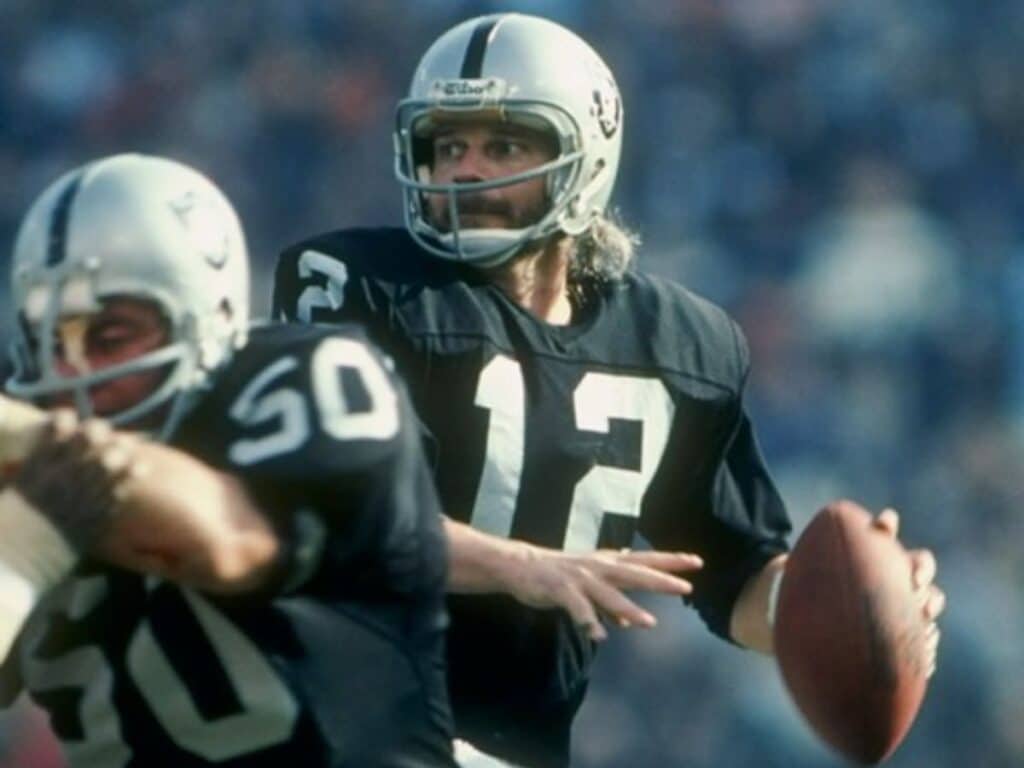
Stabler won a game and a half more than the average quarterback for his career in the regular season and postseason combined. This is significantly better than what his peers from the 1960s and 1970s did in terms of total value. This stems from him not only winning a little over a game on average in the regular season, but him almost winning 2 games above average in the postseason. Stabler was 0-2 when defenses allowed 16-20 points, which is below average as the average quarterback win those types of games at a 53% rate. However, Stabler was 1-1 when the defense allowed 21-25 points, which is above average. More importantly, Stabler was 3-2 when the defense 26-33 points, which is significantly above average. The 3-2 record is a 60% win rate compared to an average quarterback’s 17% win rate. This contributes to why Stabler’s total value record differential is as high as it is relative to his peers of his era.
Jones ended up being average for his total career value. His postseason record differential was marginally below average. He only played in three postseason games so the sample is very small. His defenses did not play well and gave up 26+ points in those games. Finding a way to win one of those games would have helped his record differential a lot. A bigger factor for Jones in increasing his total career value would have been to find a way to stay healthy so that he could have stayed productive and win more games above average for more regular seasons such as in 1978 and 1979, before the Colts rapidly declined in quality. Doing this could have helped his regular season record differential and created more playoff opportunities.
Anderson ended up being almost exactly average for his total career value. He was very marginally below average in the regular season and very barely above average in the postseason in terms of record differential. Aside from being better in the regular season, Anderson could have improved his total value record differential by being better in the postseason. He did not have good defensive support in the postseason, and he did a good job at going 1-0 when the defense allowed 21-25 points. He was 0-2 when the defense allowed 26-33 points and 0-2 when the defense allowed 34+ points, respectively. It is not a major underachievement by any stretch, but winning one of those games in those brackets would have helped his postseason record differentials a lot.
Fouts finished below a game above average in the regular season for his career but finished a little over a game above his average in the postseason. Fouts performed well by going 1-1 when the defense gives up 34+ points and by at least going 1-2 when the defense gave up 26-33 points. However, he went 0-1 (losing to the Oilers without Earl Campbell and their starting quarterback) when the defense gave up 16-20 points. This was below average since the average quarterback wins those games at a 53% rate. Had he won that game, it would have increased his postseason record differential and overall total value record differential even more so.
Bradshaw only won half a game above average in the regular season on average for his career. However, Bradshaw’s total value record differential ends up being over a game above average and his legacy is even at the level that it even is mostly because of his postseason. Bradshaw’s postseason record differential was roughly 2 games. Bradshaw never lost a game in which his defense gave up 20 points or fewer. On the flip side, Bradshaw was 0-2 when the defense gave up 21-25, which is below average. However, Bradshaw at least going 1-2 when the defense gave up 26-33 points (the second Cowboys Super Bowl victory) is above average since the average would have only won that type of game at a 17 percent rate.
Theismann finished winning over a game above average in the postseason, which is why his total value record differential ends up being close to a full game above average. Theismann went 2-0 when the defense gave up between 16-20 points and 1-1 when the defense gave up between 21-25 points. The success in both categories is noticeably above average relative to what the average quarterback would have done in those spots.
Griese ended up being very marginally below average as he won .03 games below average. This stems from him being marginally below average in terms of record differential in the regular season and postseason, respectively. His low postseason record differential can be attributed to his 1-2 record when the defense gives up 21-25 points. The 33 win percentage in that category is below the average quarterback’s win percentage of 38%. He did not make up for it by winning one of his two games in which the defense gave up 26+ points from either category nor did he 2-0 instead of just 1-1 when the defense gave up 16-20 points.
Namath’s total value is essentially average as he won only a quarter of a game above average for his career. His regular season career record differential was a little over half a game above average. Meanwhile, his postseason record differential was average because it was specifically -0.08. Namath’s postseason sample size is relatively small at only 3 games, so it isn’t big enough to draw big conclusions about the type of postseason he was or could have been. Nonetheless, his 1-0 record when the defense gives up 21-25 points is noticeable above average since the average quarterback wins those games at 38%. However, he was 0-1 when the defense gives up between 11-15 points. It is below average since the average quarterback wins those games at 76%. Had he won that game, it would have increased his postseason and total value record differential, but by only a little, since the average quarterback usually wins those games anyway.
Starr is literally average in the regular season. What makes his total value even close to a full game above average won is the fact that he won over a game and a half above average in the postseason. Starr was 1-0 when his defense allowed 26-33 points. It is well above average since the average quarterback wins those types of games at a 17 percent rate.
Dawson was basically an average quarterback in the regular season in terms of his record differential in the regular season. He was barely over half a game above average in the postseason, largely because he at least went 1-0 when his defense gave up between 16-20 points, which is above average. Winning at least one of his two postseason games in which the defense gave up 34+ points would have increased his postseason record differential and subsequently his total value record differential. As it stands, he was basically marginally above average as his total value record differential is just under a mere half a game above average.
Unitas was close to a game above average in the regular season and was a little over a game above average in the postseason. The record differentials amount to his career total value being slightly over a game above average in wins. In the postseason, Unitas did not win the games where his defenses gave up over 21 points, but he was at 3-0 when his defense gave up 16-20 points. Being well above average in this category (the two wins vs. the Giants, which included the iconic game winning drive) played a big role in him even winning a game above average in the postseason, let alone for him even having the total value record differential that he has.
In Meredith’s limited playoff games, he did not have great defensive support. However, his 0-1 record when the defense gave up 21-25 points is below average. Being 1-0 instead would have helped his postseason differential and increased his total value for his career.