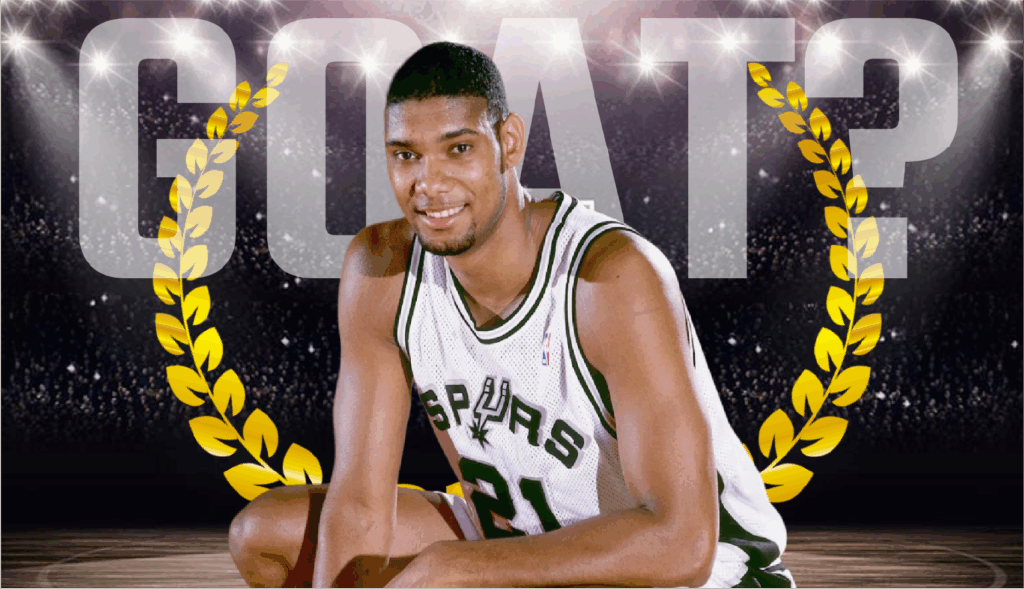
Tim Duncan is an NBA legend. 5 NBA Championships, 2 MVPs, a boatload of All-NBAs and All-Defense and All-Star nods, etc. He was an excellent defender, and a great offensive talent – he could score in the post, jump shoot, and was a very good passer and playmaker. He is widely considered the greatest power forward ever, and one of the greatest players to ever play.
And he did this for nearly 2 decades, spanning different eras of basketball from the late 90s, to the mid 2010s.
Despite Tim Duncan’s incredible career, and his status as among the league’s greatest to ever play, he is often never seriously brought up in discussions for beingthe greatest player ever. As in, number 1. And that’s a tragedy.
People say that he’s never three-peated, that he lost to the Lakers too much, that he wasn’t dominant too much, or that he had some bad first-round exits no one talks. While these have some validity to them, they lack context, and more importantly, they don’t take away from the overall value of Tim Duncan that could make him the best player to ever play.
GOAT Case #1: He’s Easy to Build Around
The Spurs didn’t need to make aggressive trades to build around Duncan. His style of play did not require the Spurs to get him specific types of players.
For example – LeBron James needs big men that can shoot 3s. LeBron James can’t play with traditional big men – he needs space to drive in at all times. And he dominates the ball a lot. This also limits offensive systems you can put LeBron in.
Shaq needs elite 2-guards that can effortlessly create their own shot AND help him defensively on the perimeter. Shaq’s defense was never as elite as other elite big men (Hakeem, Robinson, etc.)
Guys like Curry can’t anchor the defense.
But Duncan at various points in his career was able to play with different types of players – his best teammate could be the 7-foot center David Robinson, two guards in Tony Parker and Ginobili, and the 6’8 small forward Kawhi Leonard. All of them with very different usage rates and play styles.
This made it easy for the Spurs. They didn’t have to take a swing and a miss on a player that could fit Duncan. They didn’t need to force a trade to get a player that could fit with him.
GOAT Case #2: He Can Play in Different Areas
Duncan’s ability to play with all these different iterations of Spurs teams – none of which were superteams – still speaks of his versatility and scalability.
He played with another big man in David Robinson (the Twin Towers) in the late 90s. This double-big lineup could work since Ducan had a versatile scoring aresanal. He could post-up, but also face-up jump shoot with his signautre bank shot. Furthermore, he was a very unselfish player, and had the mobility to move off-ball enough to provide Robinson with spacing.
He then anchored the team in the early-mid 2000s (2003-2005) when Ginobili and Parker were just entering their primes and the team was primarily defensively-oriented during that “dead-ball” era of the NBA. During this time, Duncan played many minutes at center – a change from his time at power forward – and played the position seamlessly, being a defensive stalworth for his team for the next decade.
Lastly, he was still an anchor in the early-mid-2010s when his team – and the league – adopted more 3PT shooting. He was able to anchor his team’s defense for almost all of his career (basically as soon as David Robinson got older), and was able to fit within the team’s offense even as Parker and Ginobili had already been given the reigns offensively. Duncan’s ability to floor space, jump shoot, move around and make quick passes is what allowed the Spurs offense to flow seamlessly.
Duncan wasn’t forced to play only his way like other superstars. Duncan didn’t need a team to be molded around his skillset like Shaq or LeBron. He could shift his position and style of play enough to give his team flexibility to adapt their offense. And he did this for 19 years. And his teams won 5 championships as a result.
GOAT Case #3: He Won Without Ever Having a Superteam
Tim Duncan may have played with many different great players – Kawhi Leonard, Tony Parker, Manu Ginobili, Bruce Bowen, David Robinson, etc. But only two of these players (Kawhi and Robinson) were arguably best-player-in-the-league-level superstars – and they weren’t even at that level when they played with Duncan. (Technically Tony Parker was 5th in MVP voting in 2012, but he wasn’t a true bonafide superstar).
The David Robinson that played with Tim Duncan was a post-injury David Robinson whose offensive game was diminshed from what it was. Robinson injured his back (herniated disk) at the start of the 1996-1997 season, and it remained an issue the rest of his career. Additionally, he was already 33 by 1998 (since he was a 24 year-old rookie in 1989), so he was already moving past his athletic prime. This video showing Robinson in 2002 encapsulates this quite nicely:
Robinson obviously had better games than this when he was more healthy, such as in 2003 – but the point is that this was a nagging issue that prevented Duncan from getting to play with a true superstar teammate. Critics of Tim Duncan point out that Duncan never three-peated – but this is a major reason why. it’s difficult to three-peat when your best teammate is old and dealing with back injuries. When Kobe and Shaq won 3 in a row, they were largely healthy enough to perform at a high level throughout their playoff runs, and they were both in their 20s.
Kawhi Leonard had the opposite issue – he was healthy, but a very young project player that was still develping his offensive game. Kobe Bryant came into the league with an arleady developed and promising offensive game. Kawhi on the other hand was raw on offense, and would only hit his prime as a complete player by 2018. His defense was very good early on however. But by the time he was great enough to get major playing time, Duncan was already in his mid to late 30s. So Duncan was old and Kawhi was very young and not yet in his prime.
A lot of this depends on how you grade Ginobili and Parker. Ginobili was a fantastic player, and his willingness to be a 6th man was crucial for the Spurs. Parker was also a nifty ball-handler and scorer at the guard position. But they weren’t considered true superstars. Parker was very weak defensively, and his playmaking was not great. Ginobili was a great passer with great footwork and ballhandling, but many wonder how his game would hold up impact-wise if he were to be “the guy”. And the end of it all, Duncan anchored the defense heavily. In short, Duncan didn’t get to play with a player who could lead a team to a title, that was in their prime. Robinson was old and had debilitating back problems, and Kawhi was not yet at the level he displayed in 2017 or 2019.
Quick Rebuttals
- Threepeating is one of those things that, depending on what you value in a player, may not be a huge dealbreaker. Obviously, if you go by accolades, a threepeat can give you a leg up on others with comparable achievements. But – if you’re like us – and you just value contribution to winning, then winning rings in a row versus spread out a couple of years (like Duncan did in 03, 05, and 07) isn’t really that large of a deal. Not to mention… many of Duncan’s teams weren’t equipped enough for him to have a threepeat
- Duncan did have some bad playoff losses. No lie. But the number of them wasn’t high enough to really hurt his legacy.
- The Lakers point needs more context; most of his losses were to the Kobe-Shaq Lakers. As in, a Lakers team that had two superstar, top 10ish all-time players, playing together at the same time. Meanwhile all Duncan had during that time was an increasingly older, post-injury David Robinson. That wasn’t prime David Robinson! And Ginobili and Parker didn’t even become major pieces until 2003. (And Parker did not shoot very well in that 2003 run.) So the reality is that it was Kobe and Shaq vs… just Duncan. You can only get on Duncan for 2008, really. Which is fair!
Conclusion
To sum it up – Duncan’s skill set anchored a franchise for 20 years. He was versatile enough to allow the Spurs to slot in a variety of players around him, tweak their offensive systems, and not have to make aggressive trades to give him superstars to play with. It resulted in 5 Championships – despite playing in a toguh western conference, that also fielded one of the strognest duos ever in the Kobe-Shaq Lakers.
If you have a style of play that is effective, and can fit with different types of players, and elevate teams that don’t have other superstars, thus making it easier for your team to win games and compete for championships and win them, doesn’t that make you the best player ever? The goal is to win, and if you’re a player whose skills help a team win many games (including championships) over a long period, then you should be called the best, or be in the discussion.
If you own a franchise and you need to pick one player to build your franchise around, Tim Duncan should be the one. He is the most low-maintenance, steady and consistent, easy to build around superstar, and you’ll win many rings with him.
If you want to see more articles for our GOAT Case series, visit the page.
Feel free to give suggestions in the comments.